

What I Learned Facilitating Men’s Work as a Woman
What 3 Weeks Inside a Men’s Recovery Container Taught Me About Masculinity, Healing and Play

Me and a retreat participant watching the sun rise on our last day together in Greece.
When did the word man become such a triggering topic of conversation?
When did the containers we created for healing, connection and co-regulation become so divided?
Men over here.
Women over there.
Women healing from men.
Men learning how to be men.
The masculine trying to understand the feminine.
The feminine trying to understand the masculine.
Everyone talking about each other.
But how often are we actually sitting together?
This summer, I was invited to spend three weeks with a group of men off the coastal shores of Greece. This wasn't the first time I had been invited into a predominantly male container to show up as an embodiment of the feminine. Over the years, through teaching, facilitating, retreat spaces and simply living a very unconventional life, I have found myself invited into rooms where my role wasn't necessarily to teach men anything. It was to bring a different quality into the space. Intuition. Warmth. Beauty. Emotional awareness. Play. The ability to feel the temperature of a room before anyone says a word. What I have learned is that the feminine doesn't need to overpower the masculine to have influence, and the masculine doesn't need to diminish itself to make room for the feminine. When both are embodied, they naturally begin to organize around each other's strengths.
They were big men. Spartan-looking men. Athletes. Men carrying complicated histories. Some were recovering from addiction and learning, in a very real way, how to walk in the world again.
And then there was me.
A woman invited into a predominantly male space, not to soften them, fix them or teach them how to become more emotionally available.
I was simply there to participate in the container.
And somewhere along the way, I realized that I was learning just as much about men as anyone was learning about themselves.
Maybe more importantly, I was learning what becomes possible when men and women stop studying each other from opposite sides of the room.
Spaciousness

One of the first things I noticed was how much space men can hold.
Not necessarily conversational space.
Actual space.
Silence.
Distance.
Time without explanation.
There is something incredibly beautiful about the masculine tendency toward logic, structure and problem solving. But every strength has an opposite edge.
Structure can become rigidity.
Logic can become the need to understand everything.
Problem solving can become the belief that every uncomfortable feeling requires a solution.
So one of the practices became spaciousness.
Not fixing.
Not forcing revelation.
Not turning every difficult moment into a workshop.
Sometimes nothing needed to happen.
Sometimes someone needed to stare at the ocean.
Sometimes we needed to eat.
Sometimes we needed to move our bodies.
Sometimes we needed to sit beside each other without asking, “What are you feeling?”
There is a kind of healing that happens when nobody demands that you heal.
Boredom

We are terrified of boredom.
So much of modern life is constructed to make sure we never have to experience it.
Phones.
Food.
Work.
Sex.
Substances.
Social media.
Noise.
Even healing can become another distraction.
Another podcast.
Another workshop.
Another ceremony.
Another thing to consume.
But boredom is incredibly revealing.
When you strip away the constant stimulation, eventually you meet the space underneath it.
And that space is uncomfortable before it becomes creative.
We had to make the space before we could fill it.
That became one of the greatest lessons of the experience.
You cannot discover what you actually want when every empty moment is immediately occupied.
First comes emptiness.
Then curiosity.
Then imagination.
Imagination
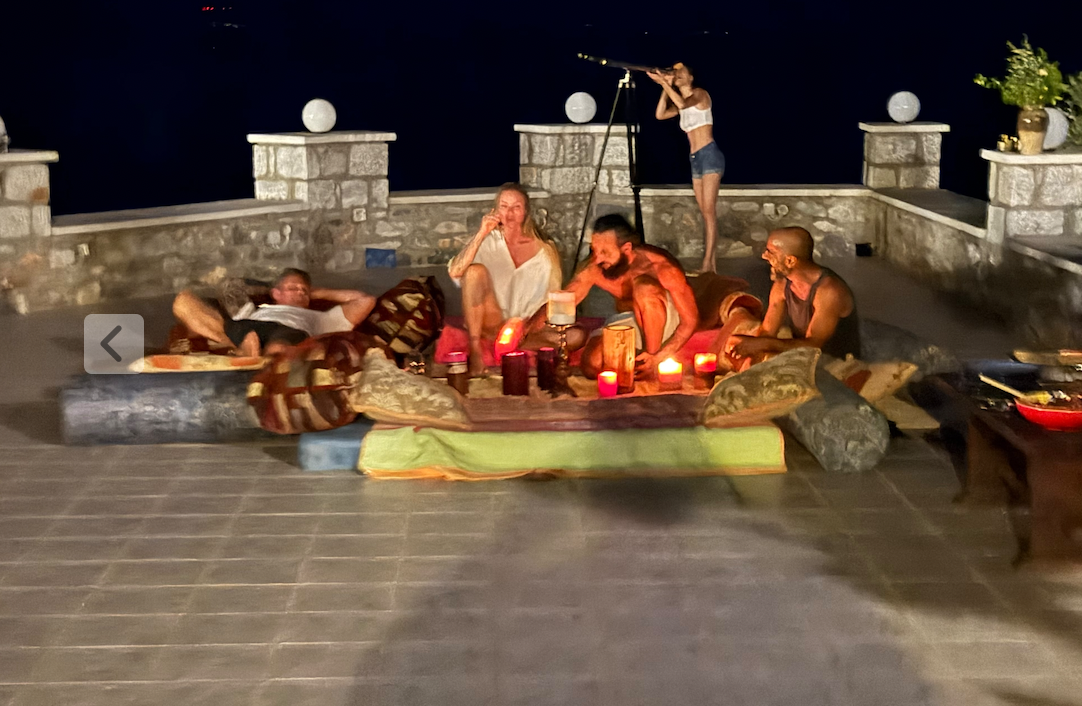
The guys experiencing their first plounge (pillow lounge). Watching the shooting stars.
The most profound conversations rarely started because someone announced that we were going to have a profound conversation.
They happened organically.
Over meals.
Walking.
Sitting outside.
Driving somewhere.
Lying around with nowhere particularly important to be.
And slowly the conversations changed.
What do you actually want?
What kind of life do you want to wake up inside?
Who do you want beside you?
What would you create if you stopped organizing your life around survival?
What do you miss?
What do you desire?
What do you dream about when nobody is asking you to be practical?
For people rebuilding their lives, imagination is not frivolous.
It is essential.
You cannot walk toward a life you have never allowed yourself to imagine.
Recovery cannot only be about removing what was destroying you.
Eventually you have to create something worth staying present for.
Play
This might have been the biggest lesson of all.
We played.
Not as an exercise.
Not because it was written on a schedule.
Not because someone announced, “Now we are going to explore our inner child.”
We just played.
And play did something that formal facilitation sometimes cannot.
It made us equal.
In play, the hierarchy disappeared.
There wasn't always a teacher and a student.
A facilitator and a participant.
A healer and someone being healed.
There were just humans figuring each other out.
Laughing.
Competing.
Teasing.
Trying things.
Failing at things.
Learning where someone's boundaries were.
Learning when to push and when to stop.
Learning how another person communicates without needing them to explain themselves.
Play became a form of co-regulation.
And the whole experience became the workshop.
From the moment we woke up until the moment we went to sleep, we were learning through proximity.
Through observation.
Through friction.
Through laughter.
Through silence.
Through meals.
Through conflict.
Through repair.
There was no clean line between “the work” and life.
Life was the work.
Balance
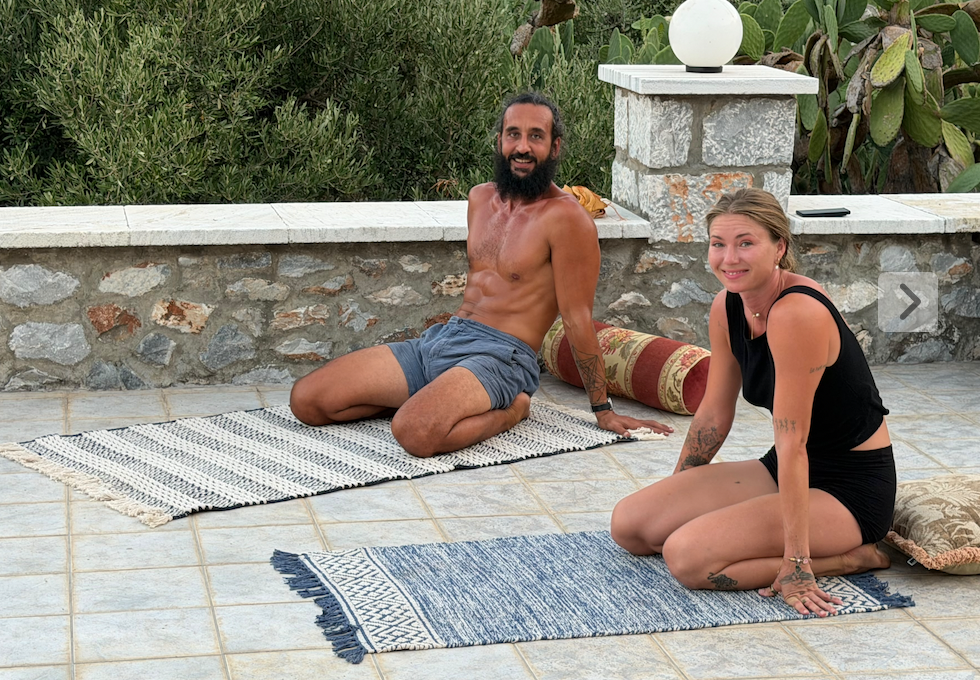
Me and the other facilitator playing around practicing our headstands at sunrise yoga.
And then there was something I didn't expect to become so obvious.
How easy things can feel when embodied masculine and feminine energy stop competing for the same role.
I watched how naturally the men moved toward creating foundation.
Where are we going?
What needs to happen?
What needs to be carried?
What is the plan?
Is everyone taken care of?
Is the environment secure?
There was pleasure in providing something tangible.
And I realized how much pleasure I experienced in receiving that foundation and then filling it.
Making the table beautiful.
Creating warmth.
Bringing people together.
Feeling when the energy had shifted.
Knowing when someone needed laughter, conversation, food, quiet or simply another human nearby.
One was foundational.
The other was emotional.
Neither was more important.
And neither could create the entire experience alone.
The masculine could build the house.
The feminine could help make the house feel like somewhere you wanted to live.
And sometimes, of course, those roles reversed.
That might actually be the point.
Healthy polarity isn't a prison of gender roles. It is the freedom to recognize where someone is naturally strong and let them lead there.
Sometimes he knew.
So I followed.
Sometimes I knew.
So he followed.
There wasn't a constant negotiation over who was in charge.
There was responsiveness.
That is what I think we sometimes miss when we talk about masculine and feminine dynamics.
We make it about dominance.
Who leads?
Who submits?
Who provides?
Who receives?
But what I witnessed felt much more intelligent than that.
Leadership moved.
It belonged to whoever had the clearest relationship to what the moment required.
The beauty was not in a man always leading or a woman always receiving.
The beauty was in not needing to compete.
When two embodied people trust one another enough to let the other person lead where they are strongest, there is an incredible amount of energy freed up.
No one has to do everything.
No one has to prove everything.
You get to bring your gift.
I get to bring mine.
And together we create something neither of us could have created alone.
That balance was one of the most beautiful things I witnessed in Greece.
Not masculine versus feminine.
Masculine with feminine.
Foundation with feeling.
Structure with intuition.
Direction with responsiveness.
Strength with softness.
And when both were allowed to exist fully, there was an almost effortless harmony to it.
What Women Can Learn in Men's Spaces
There is something important about women having spaces that belong entirely to women.
There is something important about men having spaces that belong entirely to men.
But I wonder if we have become so focused on creating safety through separation that we have forgotten another form of healing.
Being witnessed by the people we have learned to fear, misunderstand or reduce to an idea.
Because I could read a thousand books about men and still not learn what I learned by living beside them.
And they could attend a hundred workshops about feminine energy and still not necessarily understand a woman.
Sometimes understanding happens through proximity.
You watch.
You listen.
You notice.
You stop making everything personal.
You begin seeing the other person as a human being rather than a representative of their gender.
And strangely, that gives you a deeper understanding of gender too.
I became more aware of my own feminine nature because I was surrounded by men.
And I watched men become more aware of their softness without anyone demanding softness from them.
That distinction matters.
Men's Work Is Different
I also learned that I could not facilitate men exactly the way I might facilitate a women's retreat.
Not because men do not have emotions.
Not because men do not need tenderness.
And certainly not because vulnerability is feminine.
But because the doorway can be different.
Sometimes vulnerability between men emerges sideways.
While doing something.
While walking.
While working.
Through humour.
Through challenge.
Through silence.
Through being useful to one another.
Through someone proving, over time, that they are not going anywhere.
There was a degree of stoicism in the container, but I came to understand it less as emotional suppression and more as steadiness.
Not every emotion needed to become the centre of the room.
Not every discomfort needed an audience.
Sometimes love looked like giving someone space.
Sometimes compassion looked like expecting more from them.
Sometimes support looked like refusing to rescue them.
And sometimes the safest thing you could communicate was:
I trust you to stand.
Women-Led Men's Circles
This is where the experience challenged me the most.
What is the role of a woman in a men's healing space?
I don't think it is to teach men how to become the kind of men women want.
I don't think it is to feminize the container.
And I don't think it is to position women as the emotionally evolved gender arriving to show men how to feel.
Maybe the role is much simpler.
To witness.
To offer another nervous system in the room.
To bring the feminine without demanding that men perform masculinity differently around it.
And perhaps most importantly, to allow men to encounter a woman who does not need to rescue them, fear them, control them or extract emotional proof from them.
A woman can bring softness without making the room soft.
She can bring intuition without removing structure.
She can bring care without removing consequence.
She can hold compassion while still expecting accountability.
And men can offer something equally profound in return.
Ground.
Structure.
Directness.
Protection.
Humour.
Perspective.
Space.
Not because every woman embodies one thing and every man another.
But because when different ways of moving through the world are allowed to meet without immediately competing, correcting or diagnosing each other, something begins to integrate.
Maybe that is part of what masculine and feminine integration actually means.
Not endlessly talking about the masculine and feminine inside ourselves.
But learning how to remain ourselves while standing beside someone different from us.
Maybe We Need Each Other
There are wounds that require separation.
There are seasons when women need women.
There are conversations men may only be able to have honestly when no women are present.
Those spaces matter.
But separation cannot be the final destination of healing.
Eventually we have to come back into relationship.
Eventually the nervous system has to discover that difference does not automatically mean danger.
Eventually we have to practice being human together again.
Because the goal was never to create perfectly healed men and perfectly healed women living in separate circles.
The goal is relationship.
Friendship.
Community.
Family.
Love.
The ability to disagree without abandoning one another.
The ability to witness pain without immediately fixing it.
The ability to hold strength without being frightened by it.
The ability to hold softness without exploiting it.
Three weeks living beside these men taught me something no workshop on masculine and feminine dynamics ever could.
We do not always need another framework for understanding each other.
Sometimes we need enough spaciousness to observe.
Enough boredom to become curious.
Enough imagination to create something different.
And enough play to remember that underneath all of our ideas about men and women, masculine and feminine, healer and healed...
we are humans trying to learn how to walk in this world together.
